
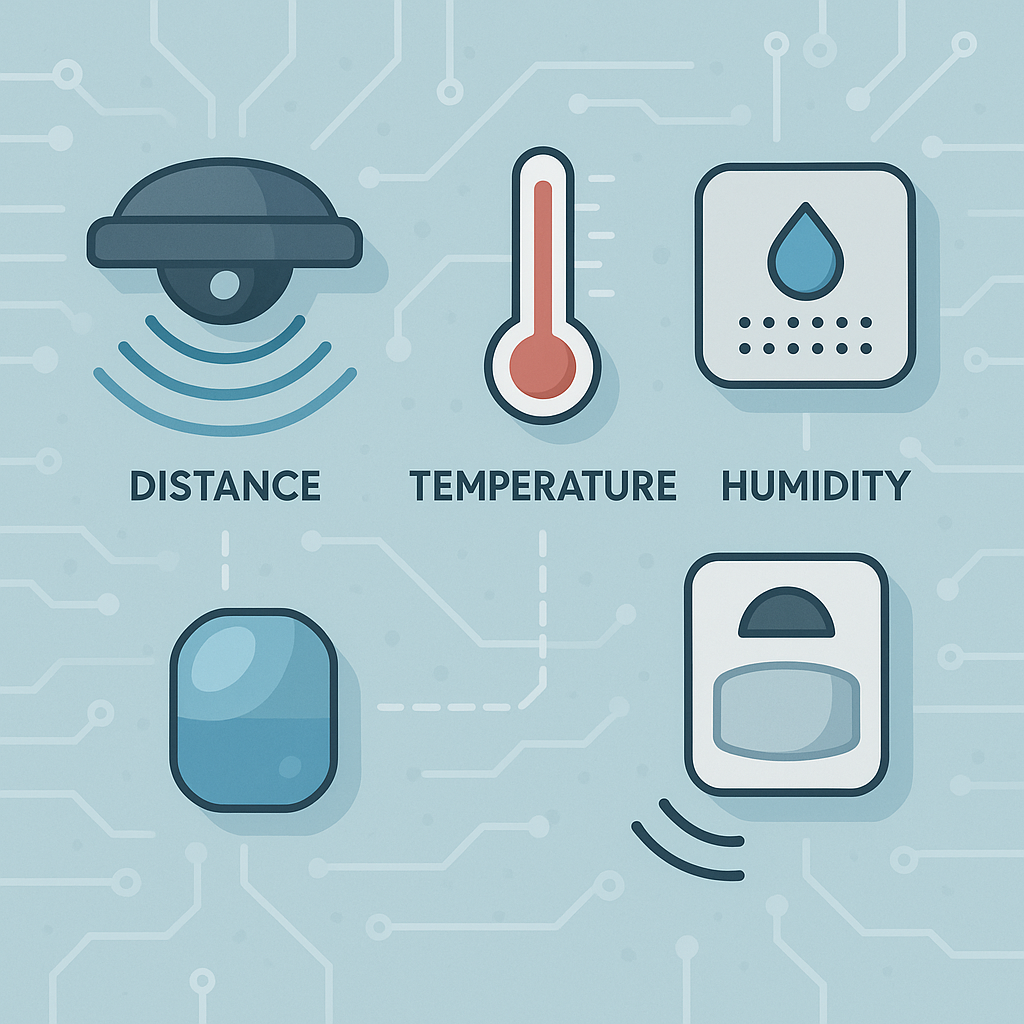
Advanced Distance, Temperature, Humidity, and Motion Sensors: Principles, Technologies, and Examples
Why advanced sensors matter today
Sensors are the “sense organs” of modern systems: they allow robots, smart buildings, production lines, and consumer devices to perceive the physical world and respond in an informed way. The technological evolution of recent years has made precise, low-power solutions with standard interfaces accessible, paving the way for increasingly sophisticated use cases. In this article we explore four key categories — distance, temperature, humidity, and motion — reviewing the main technologies, selection criteria, integration tips, and concrete examples.
Distance sensors
Main technologies
Distance sensors measure the space between the device and an object. The most widespread technologies include:
Ultrasonic: they emit acoustic waves and measure the echo return time. They are inexpensive and work well on opaque surfaces, with a typical range from a few centimeters to a few meters. Sensitive to airflows, temperature, and angle of incidence.
Optical Time-of-Flight (ToF): measure the time taken by infrared light to return to the sensor. Compact and accurate at short distances (up to a few meters), with high update rates and good millimetric resolution.
Lidar: emit lasers and map distances on a plane or in 3D, ideal for mobile robotics, SLAM, and autonomous vehicles. They offer long range and high point density, but higher costs and power consumption compared to single-point ToF.
mmWave radar: use electromagnetic waves in the millimeter band (e.g., 60–77 GHz). Work well in the presence of dust, smoke, and fog, with the ability to measure velocity (Doppler) and distinguish multiple targets.
Selection criteria
Define usable range and desired resolution; assess the required update rate (tracking vs spot measurement), environmental conditions (sunlight, dust, reflective surfaces), field of view, budget, and mechanical integration. Also consider the interface (I2C, UART, SPI, CAN), power supply, and electromagnetic compatibility (EMC).
Application example
A mobile warehouse robot can combine a 2D Lidar for long-range environment mapping with small front ToF sensors to avoid close obstacles and an mmWave radar to detect operators in dusty conditions. In this way it maximizes safety and operational continuity.
Temperature sensors
Technologies and specifications
Thermistors (NTC/PTC): inexpensive, very sensitive but non-linear. Require calibration curves; ideal for process control and thermal management in electronics.
RTD (e.g., PT100/PT1000): platinum resistors with high accuracy and stability, linear over a wide range. Preferred in industrial and laboratory settings.
Thermocouples: cover extended ranges (up to 1000 °C and beyond) and withstand harsh environments; require cold junction compensation and amplification.
IR thermometers (thermopile): measure infrared radiation emitted by objects without contact. Perfect for moving or inaccessible surfaces, but sensitive to emissivity and ambient conditions.
Best practices
Provide ambient temperature compensation (especially for humidity and IR sensors), minimize self-heating with low measurement currents, ensure good thermal coupling to the measurement point, filter electrical noise, and use periodic calibrations when needed. Response time depends on thermal mass: halve the mass and you (roughly) halve the response time.
Application example
In fermentation control, a PT100 RTD inserted in a stainless steel sheath ensures stability and accuracy, while an IR thermometer monitors the fermenter’s surface temperature to detect stratification. The algorithm applies a weighted moving average filter to attenuate transient spikes.
Humidity sensors
Technologies and challenges
Capacitive: use a hygroscopic polymer whose dielectric constant varies with relative humidity. Offer good accuracy (±2–3
Resistive: the material’s resistance changes with moisture absorption. They are inexpensive but more prone to drift and contamination.
Dew point: chilled mirror sensors provide extremely accurate metrological references, typical of laboratories and quality control.
Example and data
In a greenhouse, a capacitive sensor integrated with a thermometer automatically compensates temperature to estimate relative humidity. Data are sampled at 1 Hz and averaged over 60 s to control irrigation and ventilation.
timestamp, temperature_C, humidity_RH
2025-05-01T08:00:00Z, 22.1, 61.2
2025-05-01T08:01:00Z, 22.2, 61.0
2025-05-01T08:02:00Z, 22.3, 60.8
Motion sensors
Technologies and applications
PIR (passive infrared): detect variations in IR radiation emitted by bodies. Ideal for low-power human presence detection, with a wide field of view. Do not provide precise speed or direction.
IMU (accelerometers, gyroscopes, magnetometers): measure accelerations, rotations, and magnetic field to reconstruct attitude. Fundamental in robotics, drones, wearables, and camera stabilization. Require calibrations (bias, scale) and filters (Kalman, complementary) to contain drift.
mmWave radar for presence and respiration: can detect micro-movements at a distance, useful for people counting, occupancy monitoring, and safety in environments hostile to PIR or cameras.
Application example
In an office, the combination of an mmWave radar and a PIR reduces false positives: the PIR activates the system, the radar confirms presence and estimates distance. An accelerometer on a door detects openings/closings to correlate access events with actual occupancy.
Integration, communication and power
Interfaces and protocols
In the embedded world, I2C and SPI prevail for highly integrated digital sensors, while UART simplifies stand-alone modules. In industrial settings, 4–20 mA, 0–10 V, Modbus RTU/TCP, CAN/CANopen are common. The choice impacts wiring, noise immunity, speed, and communication distance.
Power management
For battery-powered devices, use aggressive duty cycles, low-power modes, wake-on-motion thresholds, and adaptive sampling. Evaluate the energy cost of each measurement: for example, a ToF may consume more than a PIR, so setting up low-power “guardians” that activate more power-hungry sensors only when needed is a winning strategy.
Sensor fusion and analytics
Fusing multiple sensors improves robustness and reliability. Kalman filters, Bayesian models, and lightweight neural networks (TinyML) enable more stable estimates of state and context. Synchronize timestamps at the source (monotonic clock or PTP on the network), document sampling rates and delays to avoid aliasing and phase shifts.
Quick examples of configuration and readings
Configuring an environmental sensor with higher oversampling reduces noise at the expense of latency. Example on the I2C bus for an environmental module:
i2cset -y 1 0x76 0xF4 0xB7
i2cset -y 1 0x76 0xF5 0xA0
Typical payload from an IoT node combining distance, temperature, humidity, and motion measurements, ready for MQTT/HTTP:
timestamp: 2025-05-01T08:05:00Z
distance_mm: 534
temperature_C: 22.4
humidity_RH: 45.1
imu_accel_mps2: [-0.01, 0.00, 9.80]
imu_gyro_dps: [0.02, -0.01, 0.00]
pir: 1
radar_mmwave_targets: 2
Selection, testing and maintenance
Define requirements before choosing: range, accuracy, response time, operating environment, interface, and budget. Rapidly prototype with development boards, then move to environmental tests: extreme temperature/humidity, electromagnetic interference, shock, and vibration. Plan maintenance: optical cleaning for Lidar/ToF, dust filter replacement, periodic recalibration of humidity and temperature. Document firmware versions and calibration curves to ensure traceability.
Conclusions and next steps
The combination of distance, temperature, humidity, and motion sensors makes it possible to build context-aware systems that can act safely, efficiently, and predictively. Choosing the right technology, together with careful integration, intelligent filtering, and an appropriate power strategy, is what distinguishes an interesting prototype from a reliable product in the field.
Do you want to design or optimize a sensing platform for your product or plant? Contact us for dedicated consulting: we will help you select the best components, define the architecture, build the proof of concept, and scale to production with solid data and informed decisions.
Comments